


31.07.2026
According to a recent Deloitte study, 27 percent of large German companies are already using AI agents in production — and the trend is rising. Individual users often notice significant efficiency gains after a short time, for example through automated routine tasks and shorter processing times. However, when multiple people on a team use these systems together, new challenges emerge:
- How does knowledge stay current and reliable?
- How can new capabilities be provided centrally and reused?
- How do AI agents support a team consistently in everyday work?
- How does their use remain controlled, cost-effective, and scalable?
We spent two days exploring these questions in the ORAYLIS Innovation Lab. Our key finding: technology is no longer the bottleneck today. What matters is a shared knowledge base, clear governance, and professional development processes.
The five key insights at a glance:
- The knowledge base has a greater impact on the quality of AI agents than the language model does.
- AI agents need professional development processes with versioning, reviews, and releases.
- The more capabilities AI agents acquire, the more important governance and lifecycle management become.
- Task-specific use of language models improves cost and speed.
- An AI Workspace brings together knowledge, tools, governance, and AI agents into a single shared working environment.
In this article, you’ll learn how we built an AI Workspace on Azure and what lessons this yields for the productive use of AI agents.
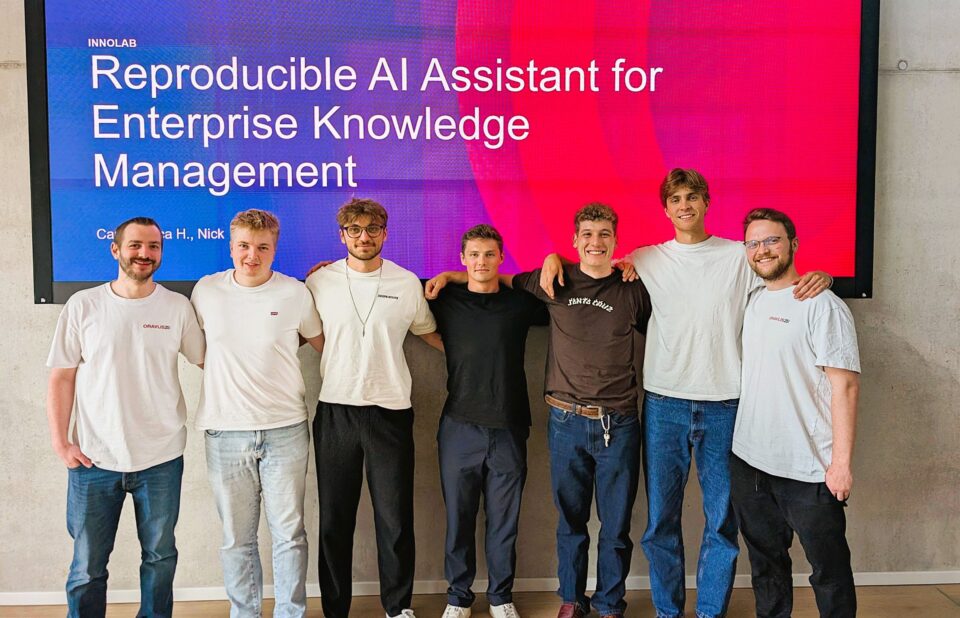
An interdisciplinary team of ORAYLIS experts explored every question around the topic of AI Workspace in Azure during the Innovation Lab (left to right): Daniel van Schadewyk, Nils Großepieper, Luca Zeuch, Luca Hackbarth, Nick Schüssler, Theo Peschers, Alex Miller. (ORAYLIS)
What is an AI Workspace?
An AI Workspace is a digital working environment that treats generative AI not merely as a separate tool, but integrates it deeply into the infrastructure, data foundation, and workflows. As a result, the workspace enables shared use of knowledge, the development of new capabilities, and their controlled rollout across the team.
In our Innovation Lab, we wanted to find out which specific building blocks this requires in Azure, and which obstacles only become visible in practical use. Against this backdrop, we first built a technical platform, which was ready in a short time thanks to agentic coding. For further testing, the setup was complemented by an AI agent named Hermes. The collected knowledge of ORAYLIS served as our data foundation.
The major challenge lay in handling this information. Both organizational and subject-matter knowledge had to be made available in a way that let everyone involved access it consistently and develop it further together. As a result, we consolidated all the data into a central, maintainable knowledge structure that would serve as the foundation for the AI agent as well as for newly developed capabilities.
1. The knowledge base determines quality
We captured organizational knowledge in structured Markdown files following the Org-as-Code approach. This describes teams, roles, responsibilities, and processes in a consistent, version-controllable way. This allows Hermes to better understand organizational relationships and factor them into its answers. Over the course of the lab, another benefit emerged: unclear, missing, or contradictory information quickly became visible. Org as Code therefore not only provides a reliable knowledge base for the agent, but also supports quality assurance of the organizational knowledge itself.
For subject-matter knowledge, we used the Organizational Knowledge Framework. It complements the organizational structure with a linked knowledge model: subject-matter content is enriched with metadata, tags, and relationships between relevant topics, projects, and documents. This gives Hermes targeted context and allows it to classify information far better than with a classic document search. One finding stands out in particular: the quality of the answers depends far more on the knowledge base than on the language model used. The better the information was structured and interlinked, the more clearly Hermes recognized the relationships, and the less often the agent hallucinated.
And what about continuously expanding the AI Workspace with new knowledge? Here, Hermes picks up information from conversations, assigns it to the appropriate knowledge structure, and makes it available to other users. At the same time, this revealed a downside: without clear rules, inconsistencies arise. New content therefore needs to be reviewed, versioned, and released in a controlled manner.
Our takeaway: it is not the language model that determines the quality of an AI Workspace, but a structured knowledge base with clear processes.
2. AI agents need professional development processes
At the outset, everyone involved worked in the same development environment. This meant new skills, configurations, and insights were immediately available to everyone, which sped up knowledge sharing. However, it also meant that changes immediately affected everyone else. Unfinished adjustments made independent work more difficult and led to conflicts.
For this reason, each developer should work in their own workspace or worktree. The team reviews changes and then merges them into the shared environment in a controlled way.
Our takeaway: AI agents learn collectively, but they need the same development processes as traditional software — with versioning, reviews, and releases.
3. The more capabilities, the more governance is needed
The easier it became for Hermes to create new skills, the faster its range of capabilities grew. At the same time, duplicate skills, differing approaches to the same problem, and redundant integrations began to appear. The challenge was no longer developing new capabilities — what mattered was keeping the growing number of functions permanently manageable.

New technologies are regularly tested for their practical applicability and real-world benefit at the ORAYLIS Innovation Lab. (ORAYLIS)
AI agents therefore call for a clear lifecycle. Teams must maintain, version, review, and retire skills in a controlled way. Only this keeps quality intact over the long term.
Our takeaway: the more capable AI agents become, the more important governance and consistent lifecycle management become.
4. The right model for the right task
In the lab, we initially used the same, highly powerful language model for every request, regardless of whether Hermes needed to perform complex analyses or simply look up information. In terms of result quality, this approach worked fine. Economically, however, it was inefficient: simple tasks incurred unnecessary costs and lengthened response times.
For production environments, we therefore recommend using model routing. The AI Workspace automatically decides which language model can handle a given request most efficiently. High-performance models are used where they deliver real added value, while smaller, more cost-effective models handle simple tasks.
Our takeaway: flexibly using different language models has a positive effect on both cost and performance.
5. An AI Workspace is more than a chatbot
Over the course of the lab, Hermes kept evolving. It didn’t just answer questions — it drew on the shared knowledge base, created new skills, and integrated tools for recurring tasks.
It became clear, accordingly, that an AI Workspace is far more than an interface for conversing with a language model. It brings together knowledge, tools, development processes, and governance into one shared working environment.
Our takeaway: the real value doesn’t come from individual AI agents, but from a platform on which knowledge and capabilities can grow together.
Conclusion
Our Innovation Lab showed that developing AI agents and putting them into productive use is no longer the problem. The real challenge is keeping them permanently manageable, especially when multiple people on a team are working with them. The easier it becomes to extend AI agents in this context, the more important a shared knowledge base, clear governance, and professional development processes become. Only this keeps knowledge, capabilities, and behavior consistent over the long term.
In other words: it is not the infrastructure or the language model that determines the long-term success of agent deployment, but the quality of the knowledge and how change is managed. An AI Workspace provides a solid foundation for this. It brings AI agents, knowledge, tools, and governance together into a shared working environment, making it possible to deploy AI productively and scalably within individual teams over the long term.
At the same time, AI implementation needs to be considered holistically across the entire organization. Operations, maintainability, security and permission concepts, as well as CI/CD, deployment, network integration, and monitoring must be factored in from the very beginning. The real task, then, is not simply getting an AI solution up and running once, but operating it reliably, securely, and in a way that allows it to keep evolving over the long term.
About the author

Alexander Miller
Consultant – AI Engineering
Alexander Miller is a Consultant – AI Engineering at ORAYLIS. His thematic focus is on generative AI, agent systems, and the corresponding infrastructure in Azure. He develops production-ready AI applications for companies, from the initial idea through to implementation. In doing so, his overarching goal is always to bring technology, business requirements, and the people who work with these solutions together in a meaningful way.


Kommentare (0)